It appears that your browser does not support JavaScript, or you have it disabled. This site is best viewed with JavaScript enabled.
If JavaScript is disabled in your browser, please turn it back on then reload this page by clicking here.
Rice Mill Lofts in Architectural Record
Affordable, green housing for New Orleans
date: 4/1/2007

wayne troyer
wayne@studiowta.com

nancy bowden stewart
nancy@studiowta.com

tracie lynn ashe
tracie@studiowta.com

julie kaminski
julie@studiowta.com
LEED AP

toni dimaggio
toni@studiowta.com

sergio padilla
sergio@studiowta.com

AWARDS

2008 - New Orleans AIA Awards
Award of Honor:
The Rebuild Center

June 2007 - New Orleans Magazine
Best New Architecture

May 2007 - AIA Regional Modernist Exhibit at the Ogden Museum of Southern Art

2007 - Gulf States Region AIA Awards
Honor Awards:
Studio WTA
Lallage Feazel Wall Residential College
Honor Citation:
PJ's Coffee Shop

2007 - AIA Louisiana Awards
Awards of Merit:
PJ's Coffee Shop
Lallage Feazel Wall Residential College

2007 - AIA New Orleans Awards
Award of Honor:
Studio WTA
Awards of Merit:
Rice Mill Lofts, LLC
PJ's Coffee Shop
Lallage Feazel Wall Residential College


FIRM OVERVIEW

Wayne Troyer Architect is a full service architectural and interior design firm based in New Orleans. The firm places a particular emphasis on developing collaborative relationships with clients by engaging in an open dialogue throughout the design process. By allowing the clients expectations to actively inform our exploration of design solutions, we strive to address specific requirements of the site and program while balancing budget and aesthetics. Our approach to design is based on identifying the functional requirements of the program, resolving problems, and discovering new types of connections that promote positive experiences. A collective approach is used in every project embracing process as the art of developing an architecture that is responsive, appropriate, and provocative. We regularly work on a variety of project types including programming, planning and designing of new facilities, commercial interiors, and adaptive reuse and restoration of existing structures. We also have successful collaborative associations with nationally recognized design firms on award winning projects including Mack Scogin Merrill Elam Architects, Davis Brody and Bond, Moore Ruble Yudell Architects & Planners, and Vincent James Associates Architects. The firm's clients include educational institutions, corporations, developers, and private residential clients.

3901 Tchoupitoulas Street
New Orleans Louisiana
Owner/Client
Preservation Resource Center of New Orleans
Size
4,024 sq. ft.
Duration
2004-2007
Summary
Existing building renovation into a 4 unit apartment building.
Design Team:
Wayne Troyer
Credits:
Photography: Sarah Essex
Lengsfield Lofts
610 John Churchill Chase Street
New Orleans Louisiana

Owner/Client
Sean Cummings / ekistics
Size
Existing: 60,246 sq. ft.
New: 11,463 sq. ft.
Total: 71,709 sq. ft.

Duration
2003-2005
Summary
Originally a box packing and manufacturing company in the Warehouse District, the Lengsfield Building has experienced several modifications over the course of its life. The newest occupants are residents of the city who are able to take advantage of the minimal design aesthetic of an existing building fitted with a new contemporary architecture: Open, mutable space as a living environment is rare in the heart of an established urban landscape, but the loft units at Lengsfield were envisioned with this specific quality in mind. Masonry walls, bare concrete floors, exposed pipes and historic steel frame windows contrast with the modern materials in the minimalist kitchens, bathrooms, and sleeping quarters for twenty lofts, five penthouse units and four artist live/work studios at street level. Oversized moveable panels of translucent polycarbonate add to the distinction between the existing architecture and new elements, and reinforce connections between zones by allowing spaces to open up into one another.
The five unit new construction penthouse features large expanses of glass, providing residents with generous views of the city. A low profile of shapes helps to distinguish public from private spaces, and the industrial feel of the building is carried through with the use of metal components on the exterior. The artist live/work spaces are located on the first floor along Tchoupitoulas Street, and have the same distinctive metal cladding exteriors. This cladding, along with the unit entry doors, initiate a proportional engagement between the large masonry Lengsfield building and the pedestrian level of the street.
Design Team:
Wayne Troyer Sarah Forrest
Credits:
Photographs: Tracie Ashe, Neil Alexander
PJ’s Coffee Shop
Tulane University
New Orleans, Louisiana

Owner/Client
Tulane University Campus Brew, LLC
Size
952 sq. ft.
Duration
2002-2004
Summary
PJ's Coffee Shop is a recipient of a 2008 national AIA Award for Small Projects. It received an Honor Citation from the Gulf States chapter of the AIA in 2007 and an Award of Merit from the New Orleans chapter of the AIA in 2007.
Running parallel to Freret Street, Tulane University’s Percival Stern Hall spreads itself across the school’s main axis of movement, and would cut off unbroken travel but for a large breezeway allowing unhindered traffic flow. With usable covered space of 6240 square feet and overall height of 16’-4”, the large open area was chosen as the site of a coffee shop for PJ’s Coffee Company, and proved an ideal place for a small installation piece of architecture.
Arrangement of the shop within the space was governed by utilization of the breezeway: A constant flow of pedestrians, bikers and wind moves along an east-west route, mainly in the southern portion of the space. This installation anchors itself between the four existing columns of Percival Stern [only directly touching two of them], slightly more to the north. This preserves the generous thruway, while the light materials make an elegant contrast to the imposing structure of the existing building. The physical separation of the new and old structures emphasizes the transitory nature of the architecture.
The south facade is the public edge and presents itself as a full height glass storefront curving between [but not touching] the columns, maintaining and respecting the physical element of movement that characterizes the space. Interior and exterior are connected visually, and linear staging of the shop ensures that movement within the building will emulate that of the outside. Translucent glass on the north façade provides privacy for the office and storage areas of the program.
Design Team:
Wayne Troyer Irene Keil Tracie Ashe
Credits:
Photography: Neil Alexander, Wayne Troyer
St. Elizabeth's Condominiums
1314 Napoleon Avenue
New Orleans Louisiana

Owner/Client
KFK Group
Size
59,000 sq. ft.
Duration
2003-2006
Summary
Built in the 1860’s, three-story Saint Elizabeth’s on Napoleon Avenue is a landmark building in the heart of Uptown New Orleans. An excellent example of Italianate Design, Saint Elizabeth’s carefully preserves the historic character in its renovation into 28 individually designed flats and townhouses. Unit design has taken advantage of high ceilings, rich wood floors, exposed brick walls, and ornate fireplace mantels. Oversized doors with transoms and multi-paned windows give added character to an already unique structure.
Originally an orphanage, then a private residence and entertainment venue, Saint Elizabeth’s encompasses an entire city block. Pains were taken to keep the exterior true to its historical detail along its main Prytania, Napoleon, and Perrier Street Facades. The fourth elevation, located at the rear of the property, consists of five new townhouses; these act as a shield to the complex’s parking and a modern face to the neighborhood.
The townhouses are an inspired modern interpretation of the historical structures that share the property. The restrained street face is contrasted by the bold court side elevation which features an rhythmic interpretation of the two story porches inhabiting the historical building. The eave detail is a simplified adaptation of the orphanage’s more ornate detailing.
Design Team:
Wayne Troyer Tracie Ashe
Credits:
Photography: Neil Alexander, Wayne Troyer
Studio WTA
1119 Tchoupitoulas Street
New Orleans Louisiana

Owner/Client
Tchoupitoulas Studios, LLC
Size
Existing: 3,942 sq. ft.
New Lofts: 842 sq. ft.
Total: 4,785 sq. ft.
Duration
2004-2006
Summary
Studio WTA received Honor Awards from the Gulf States and New Orleans chapters of the AIA in 2007.
The existing one story warehouse adjoining the Lengsfield Packaging building was used as housing for a box pres during the factory’s operation. It has been converted into an open office + studio for WTA and local artist Theresa Cole. Existing mechanical systems at the ceiling level were removed, exposing wood joists, masonry walls remained, and concrete floors were sanded and polished. The space maintains the industrial feel, as modern materials play off of the historic structure. Steel frame windows provide abundant natural light, and three openings which had been filled in over the years were replaced with windows to match the existing. A large studio space and conference room take advantage of the double height space, while other program [reproduction and resource areas, kitchen and bathroom] form the base for an open loft that overlooks the studio, providing additional workspace. A collaborative environment is encouraged and enhanced by the way space is occupied in the office, and there is a quiet elegance to the juxtaposition between old and new.
Design Team:
Wayne Troyer Tracie Ashe
Credits:
Photography: Neil Alexander
Lallage Feazel Wall Residential College
Tulane University
New Orleans Louisiana

Owner/Client
Tulane University
Size
90,000 sq. ft.
Duration
2003-2005
Summary
Wall Residential College received an Honor Award from the Gulf States chapter of the AIA in 2007.
It received an Award of Merit from the New Orleans chapter of the AIA in 2007.
Associate Architect: Ford I Dickinson Baton Rouge, Louisiana
Wall College-situated between existing residence halls-completes the perimeter of Bruff Quad, giving a sense of enclosure that reinforces the campus’ urban quality.
A raised courtyard provides entry, engaging the building with the quad; exterior corridors along upper floors reinforce the connection with the ground floor, and reference the successful open-air circulation of the neighboring halls. An interior courtyard with open walkways provides a more private iteration of the arrangement. The lobby-almost entirely enclosed in glass and entered from the courtyard-serves as a main social lounge; smaller study and social lounges open up the corners of the building where they are located, using glass walls when possible. A small warming area in each social lounge allows preparation of simple meals. These public spaces have plantation shutters on tracks that can close off the glass curtain walls in multiple configurations: They provide necessary sunscreen protection, as well as adding a dynamic quality to the building’s façade with their changing composition.
Individual student rooms contain easily moveable furniture, oversized windows with operable sections, and a built-in vanity with light and mirror, recessed to preserve valuable floor area. Two student rooms share a common bath; the stand-up shower features a floor-to-ceiling white glass window. A resident advisor apartment sits on the first floor; there are ADA compliant rooms on each floor. The Faculty Residence on the first floor includes two bedrooms, den, office, kitchen, living and dining areas, and provide a connection between school and home in an academic setting.
Design Team:
Wayne Troyer Lloyd Bray Irene Keil
Credits:
Photography: Neil Alexander
819 Forstall Street
New Orleans, Louisiana
Owner/Client
Preservation Resource Center of New Orleans
Size
1,377 sq. ft.
Duration
2006-
Summary
The neighborhood of Holy Cross in the lower ninth ward of New Orleans suffered significant damage from the levee break in 2005. The Preservation Resource Center had previously planned to introduce a series of affordable single-family homes in the area, and felt that the neighborhood would benefit from the project post-Katrina. An updated version of the earlier NEA prototype house scheme was prepared for the purposes of showcasing to residents how they could build and rebuild their homes using sustainable and affordable building techniques and materials.
The design is reminiscent of the traditional Creole cottage found throughout the city, updating and modernizing aspects to accord with the way people inhabit space today. The street front maintains the proportion and elements of the Creole cottage, while the sides and back become more playful in terms of shape and material.
The program includes kitchen, living, dining and master bedroom suite on the ground floor, with two bedrooms and a shared bath on the second. Cutouts in the second floor create light wells in unexpected places, and reinforce connections between disparate spaces within the house. Translucent polycarbonate walls introduce diffused light and blurred movement to further animate the spatial experience.
Design Team:
Wayne Troyer Tracie Ashe
Credits:

ICInola
New Orleans Louisiana
Owner/Client
Downtown Development
Size
213,995 sq. ft. on 130,770 sq. ft. of land
Duration
2006-
Summary
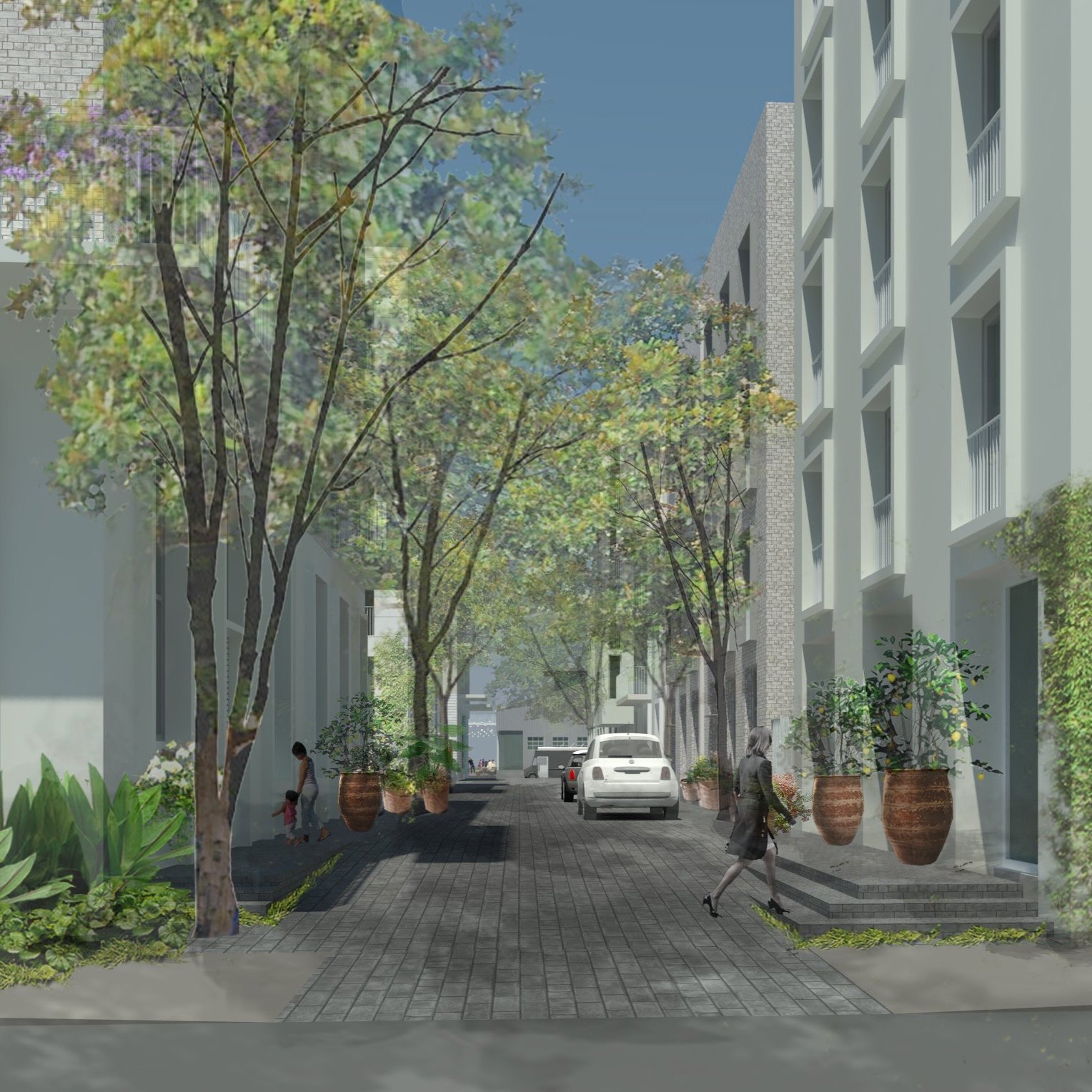
On four city blocks in the Bywater neighborhood, ICInola is a mixed-use development that includes residential and small business components. The project has gone through the schematic design phase, and is now in the process of securing approvals from several city agencies before moving into design development.
The goal of the project is to revitalize Bywater [which has been in decline for many years] into a sustainable, walkable community by promoting green technology and philosophy, densification on higher ground, investment by businesses in an area that is sorely lacking in services, and smart growth building principles.
The site is currently occupied by a 52,000 sq. ft. masonry structure [a former meat packing factory], as well as a 14,000 sq. ft. masonry building [a former social security administration office], small block shed, two historic wood frame houses, and numerous paved and unpaved city lots. The intention of the project is to relocate the two historic houses to other sites within Bywater, take down the smaller masonry building, renovate the meatpacking factory and supplement it with new construction on the other lots. The site is zoned for Light Industrial Use, and the design contains architectural aspects of that style, but it is also being designed to mediate between the existing historic buildings and the new structures being proposed. Elements of traditional New Orleans architecture are being modernized and reinterpreted in an on-going effort to design for the future while respecting the rich architectural language of the area.
Each building will contain commercial spaces on the ground floor and residential above, in the true essence of urban mixed use. Parking for residents and business patrons will be concealed within the blocks, with access via discrete driveways, and screened from adjacent properties using green screens and landscaping zones. Private outdoor space is provided for each unit, usually in the form of balconies or the more traditional New Orleans galleries, and is enhanced by shared outdoor terraces on upper levels.
Green and sustainable elements will play in integral role in the design of ICInola. Green roof systems, living walls [or ‘vertical gardens’], recycled and salvaged material, water collection cisterns to reduce load on city storm drains and provide irrigation for building landscape, passive shading and orientation in the design, geothermal heating, high efficiency appliances and fixtures, rice bale insulation and solar collectors are just the beginning of the green design for ICInola. Through design development, these and other systems will be incorporated into the project.
Design Team:
Wayne Troyer Tracie Ashe
Kenyon Zimmerman
Credits:

Rice Mill Lofts
2900 Chartres Street
New Orleans, Louisiana

Owner/Client
Sean Cummings / ekistics
Size
133,500 sq. ft.
Duration
2005-
Summary
-2007 AIA New Orleans Merit Award Winner

The Rice Mill Lofts project is located in the distinctive Bywater neighborhood of New Orleans at a historical crux of industrial activity. The Rice Mill Lofts will be an adaptive reuse of an abandoned masonry rice mill complex, which was once the largest in North America. The revitalization will introduce 20,000 square feet of ground floor commercial space along with four additional stories containing 60 loft apartments, townhouses, and penthouses interspersed with open-air courtyards and exterior terraces. In addition, the project plans to be the first multi-family LEED gold certified building in Louisiana.
The notion driving the project is a promotion of revitalization and the acknowledgment of a key industrial, historical site, while interjecting innovation and quality design in the form of a mixed-use community. The project raises the architectural design bar by implementing such building technologies as: solar energy power; wind power; passive cooling by introduction of a solar chimney and a series of open-air courtyards, excavated from the building's central core; utilization of insulated, low-E glazing at openings; establishment of a cistern for reclamation and recycling of rainwater for irrigation; landscaping with native and indigenous species; interiors that capitalize on exposed wood/masonry structure while incorporating recycled and low or non-emitting VOC materials, and mechanical systems that provide the most efficient means of energy.
The design of the rear addition was inspired by the proximate gantry cranes which dot the Port. By utilizing a Vierendeel truss, this design allows the addition to act as an extrusion of glass hanging from a single series of solid concrete columns and beams - forming the truss. The addition houses a level of residences above which a 6,000 s.f. garden level exists. At the interior of the project where certain portions will be removed and recycled to reveal exposed wood structure and create the central open-air courtyards, a series of delicate bridges will provide circulation between the programmatic elements. Another important design feature is the elegant wind turbine and solar chimney tower denoting the highest point in the project. The feature roughly marks the same location where a coal burning smokestack stood 110 years ago, and serves as a bold statement for sustainability, as the turbines will generate wind energy for powering general building utilities.
Design Team:
Wayne Troyer, Jessica Tippens, Julie Kaminski, Kenyon Zimmerman, Chris Goad
Credits:

The Chapel at St. Elizabeth's
1314 Napoleon Avenue
New Orleans Louisiana

Owner/Client
Private Owner
Size
4,924 sq. ft.
Duration
2004 -
Summary
The spectacular space of the chapel at St Elizabeths provided a special challenge in careful conversion. Having been lovingly restored by the previous owner, the chapel retained many beautiful and unique elements, including stained glass windows, marble tile floors, wood altar rail, numerous statuary and intricate plasterwork. The challenge was to convert the space into a single-family residence, including four bedrooms, kitchen, living and dining.
Not wanting to disturb the historic architecture of the chapel, the design resolved itself as a freestanding steel frame box containing the private program [bedrooms, bathrooms], floating between the chapel’s outer walls. Public spaces were located at the altar end of the chapel, with the kitchen and dining on the raised dais; living and lounge areas took up the main floor. An additional bedroom/office area was planned for the existing choir loft, which would be accessed via a straight stair serving the master suite on the second level of the steel frame box.
Modern materials and sliding panels were specified to accentuate the richness of the existing structure, and even the existing hanging fixtures were to remain. The operable portions of the stained glass windows were to have fixed clear glass installed to allow views out when the stained glass pieces were slid open. Salvaged wood planking replaced the original marble tile.
Design Team:
Wayne Troyer Tracie Ashe
Credits:

Digimation Holding Offices
St. Rose, Louisiana
Owner/Client
Digimation Holding, LLC
Size
12,401 sf
Duration
Unbuilt
Summary

Design Team:
Wayne Troyer
Credits:

The Rebuild Center
New Orleans, Louisiana
Owner/Client
Saint Joseph Church
Size
3,870 sf (enclosed); 13,000 (deck)
Duration
2006-2007
Summary
2008 AIA New Orleans Honor Award Winner

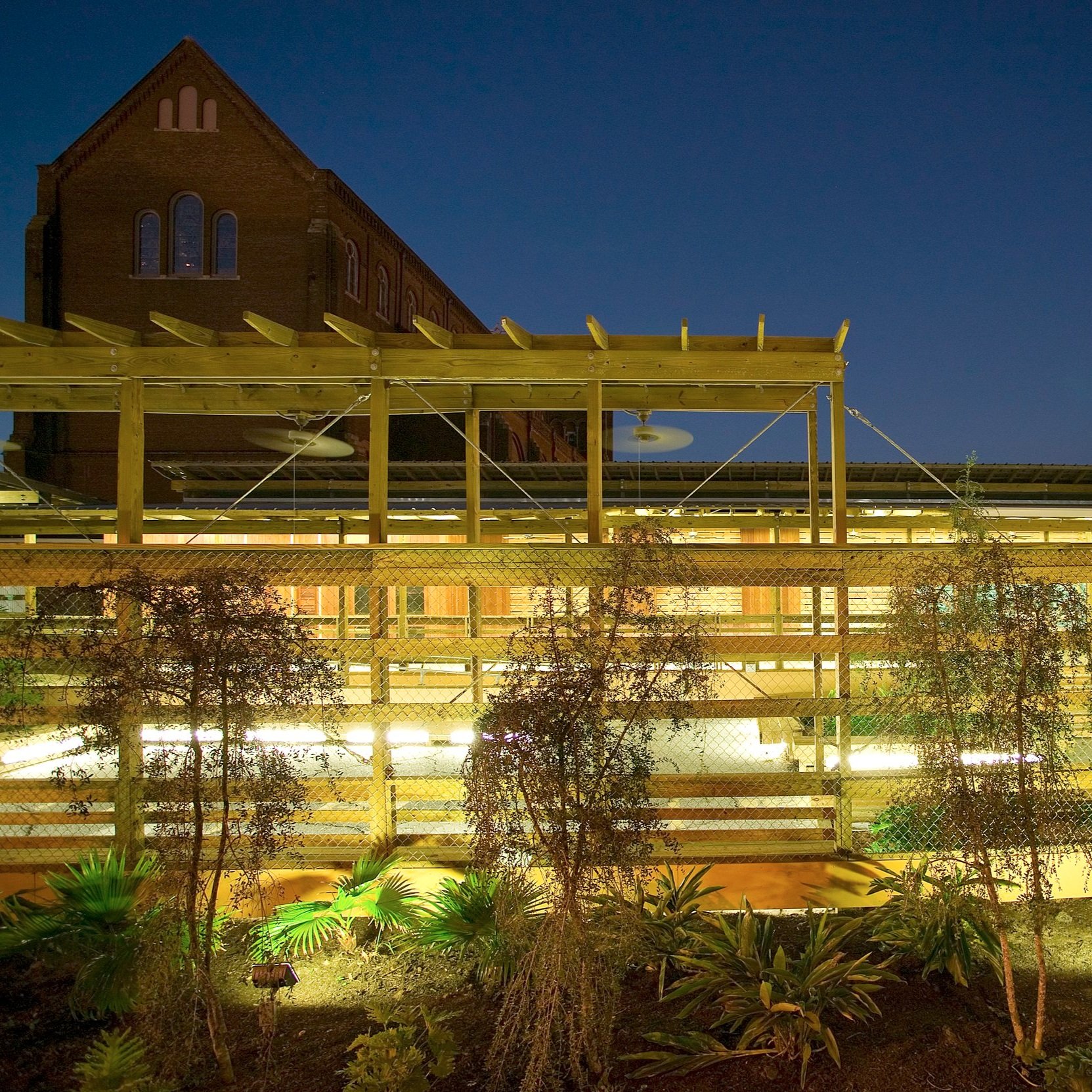
With an outreach objective to serve 250 to 300 people per day, the facility is a social service and recovery center for the burgeoning transient population of New Orleans in the aftermath of Hurricane Katrina. Organized around a landscaped courtyard and enveloped by a decorative screen of translucent polycarbonate, fiber cement board, and vegetation, the facility is comprised of six manufactured trailers connected by a raised deck. Selected areas are covered in canopies to reinforce circulation patterns and provide definition to open seating areas.
The decorative screen was developed along the street edge to function as a graphic façade for identification and to limit the negative visual impact of the trailers while providing a sense of dignity and security for the facility. Brightly painted, framed cutouts in the screen offer opportunities for visual connection with the outside and visual interest.. At night, security lights second as graphic illumination in backlighting the screen, transforming the street façade into a soft glowing beacon that can be seen from the adjacent elevated interstate. Corrugated polycarbonate roofing creates a fifth illuminated facade contrasting broad expanses of metal roof and filtering out UV rays during the day.
Additional design features include water elements, landscaped pavement cutouts, custom benches incorporating site lighting, a large water themed mural, green walls of vines, pergolas, and three custom 8’-0” x 8’-0” pivoting entrance gates.
Design Team:
Wayne Troyer Kenyon Zimmerman
in association with Detroit Collaborative Design Center
Credits:
photography: Neil Alexander renderings: kenyon zimmerman
544 Esplanade Avenue
New Orleans, Louisiana
Owner/Client
Private Owner
Size
9,803 sf
Duration
Renovation 1: 2001-2003
Renovation 2: 2004-2007
Summary
The renovation of this private residence included the residence and the rental apartment in the service wing. It entailed exposing the service wing masonry wall in the courtyard, adding a stair tower for access to the apartment, a wood gallery for the main house and a wood balcony for the apartment, modification of selected openings on the Chartres Street side, new rated walls and ceilings to separate the residence and apartment, a new kitchen and new bathrooms for the main house.
Design Team:
Wayne Troyer Sarah Forrest
Credits:

Crutcher Residence
4639 Camp Street
New Orleans, Louisiana

Owner/Client
Private Owner
Size
3,367 sq. ft.
Duration
2004-2007
Summary
The two story residence in uptown New Orleans is focused around a double height great room flanked by two story volumes, one of which contains a small tower for access to a rooftop terrace. The home is entered through a private courtyard containing landscape elements and a water feature. The two story volume is contained by a storefront glazing system which provides both visual and physical connection to a paved terrace and lap pool.
The building is constructed of wood framing on a raised slab, with some steel members. It will be primarily clad in a fiber cement board rainscreen assembly with contrasting volumes clad in cement plaster. Translucent polycarbonate sheet material is also utilized as an exterior cladding system in selected areas. Glazing components in exterior walls include fixed and operable architectural aluminum windows and aluminum storefront system, a polycarbonate and aluminum sliding barn-style door and a custom wood + glass entry door.
Interior elements include a fireplace, several polycarbonate and aluminum doors, a steel + salvaged wood staircase, spiral stair for access to the roof terrace, semi-custom kitchen cabinetry and custom bathroom vanities.
Design Team:
Wayne Troyer Sarah Forrest
Kenyon Zimmerman
Credits:

St. Joseph Condominiums
861 Carondelet Street
New Orleans, Louisiana

Owner/Client
St. Joseph Condominiums, LLC
Size
32,500 sq. ft.
Duration
2001-2004
Summary
The Warehouse District of New Orleans has experienced major revitalization of its historical structures. Within this district, the Saint Joseph Condominiums combines the adaptive reuse of existing buildings with new, contemporary architecture. Originally townhouses, then an auto dealership, and later an office building, 861 Carondelet has experienced substantial modification. With the St. Joseph Condominiums, the historic, three-story building and adjacent townhouses are respectfully renovated and two new structures are introduced. The combined task of renovation and new construction offered the challenge of maintaining the historical integrity of an existing structure while contributing to the richness of the architectural fabric of the city. The new insertions are bold, yet sensitive towards the historic context of the immediate area. The new pool pavilion, in the courtyard of the complex (invisible from the exterior), is primarily composed of translucent polycarbonate, allowing for light transmittal while maintaining privacy. During the evening hours, this graceful structure glows with an internal illumination. It faces what was once a party wall of the previous structure; an artifact left as a reminder of the building’s history. A copper-clad penthouse sits atop the newly renovated corner building, invisible from the immediate street level, yet strikingly apparent from blocks away. The copper sheeting will develop a patina over time, reflecting the passing of time also represented by the artifact-wall in the courtyard. The design concepts for the penthouse explore possible ways of responding to historic context, not by reproducing what already exists, but through interpretive + innovative use of materials, forms, and proportions.
Design Team:
Wayne Troyer Sarah Forrest Irene Keil
Credits:
Photography: Jeff Johnston
Cyber Cafe
Tulane University New Orleans, Louisiana
Owner/Client
Tulane University
Size
2,494 sf
Duration
2003-2005
Summary
The existing computer and technology lab at the University Center of Tulane University needed a new home as the extensive renovation of the Center began. The lab moved into one of the conference rooms of the Willow Street Housing, in a space adjacent to a coffee shop. The theme for the space was to be technology in a communal setting, with diversification of work environments to meet different needs. Thirty desktop stations and twenty laptop ports were arranged in five configurations, including: 3-computer group stations, a desktop computer bar, 2-computer group booths, laptop plug-in bar and wireless lounge seating. An administration/printing desk with two work stations provided an opportunity for a securable computer sales area with display and storage.
Design Team:
Nancy Bowden Stewart Wayne Troyer Tracie Ashe
Credits:

Benny's
938 Valence Street
New Orleans, Louisiana

Owner/Client
Private Owner
Size
2,228 sq. ft.
Duration
1999-2002
Summary
The renovation of Benny's was a labor of love. This was the site of many late night music jams that went on into the wee hours of the morning featuring the likes of the Neville Brothers, Mick Jagger, Keith Richards, Bruce Springsteen and tons of local musicians. The structure was deteriorated and required major foundation and shoring, especially after it collapsed during the renovation. The building was converted into a single family residence.
Design Team:
Wayne Troyer
Credits:

Benton Residence
8519-21 Zimple Street
New Orleans, Louisiana

Owner/Client
Private Owner
Size
Renovation: 1,103 sq. ft.
New: 964 sq. ft.
Duration
1999-2001
Summary

Design Team:
Wayne Troyer
Credits:

1329 Josephine Street
New Orleans, Louisiana
Owner/Client
Preservation Resource Center
Size
5,710 sq. ft.
Duration
2000-2001
Summary
The Josephine Condominiums project saved a blighted historic property from demolition. The building was previously used as 12 transient apartments prior to the conversion to four owner occupied units, two, two story townhouses and two flats in the former service wing.
Design Team:
Wayne Troyer
Credits:

"Creole Cottage"
Ursuline Street
New Orleans, Louisiana

Owner/Client
Preservation Resource Center
Size
1,303 sq. ft.
Duration
2003
Summary
The design process begins with the traditional four-room plan with rear cabinets and four-bay elevation of a Treme Creole Cottage as a point of departure. The proportions and elements inherent to this building type are adapted to form a structural/spatial framework that can easily be modified. A palette of materials with specific qualities – prefinished, translucent, simple one-step installation, durable - balances the spatial/organizational concept with the desire for affordability. As one moves through the building from front to back [street elevation to garden] and from bottom to top [living areas to sleeping areas], public spaces mesh with private spaces. Space confining/defining elements such as walls and doors are expressed with alternate materials or eliminated altogether in favor of spatial flow and continuity. The distinction between the interior and exterior is blurred by creating varied types of outdoor spaces that could easily become indoor spaces. This sense of movement and subsequent transformation is consistent with the relationship between streetscape and courtyard that is characteristic of buildings in New Orleans. The long, narrow site is both emphasized as well as utilized to manipulate the plan and spatial dynamics. This relationship is simultaneously explored in elevation. While the building respects it’s context and historical precedent in terms of scale and proportion, contemporary detailing of the individual elements hints at the digression from conventionality beyond the façade.
Design Team:
Wayne Troyer David Gregor Irene Keil
Credits:

General Taylor
600 Block, General Taylor Street
New Orleans, Louisiana

Owner/Client
Preservation Resource Center
Size
3,367 sq. ft.
Duration

Summary
The 600 block of General Taylor was a project for the Preservation Resource Center's Operation Comeback division. Guided by Stephanie Bruno, 8 blighted shotgun doubles that were slated for demolition were returned to commerce as affordable single-family residences.
Design Team:
Wayne Troyer
Credits:

Bywater Art Lofts
3729 Dauphine Street
New Orleans, Louisiana

Owner/Client
HRI Properties
Size
45,970 sq. ft.
Duration
2006
Summary
In order to fulfill the pressing need in New Orleans for affordable housing for the city's artistic community, the Art Lofts were designed as an urban infill project, in one of the most artistic neighborhoods in the city. Two existing buildings on a city block in Bywater were to be renovated as a part of the project. An abandoned sewing factory and barrel-vaulted mechanical building would contain ten and five units, respectively; on the vacant land, new construction would bring in a further 37 units in two buildings. A community room would be available for residents to hold gatherings, as well as several spaces dedicated as working areas for the resident artists [including a courtyard dedicated to metal working and sculpture making]. Parking is contained within the block, and partially hidden from view by the buildings and landscaping. Industrial materials in the new buildings would complement the existing industrial nature of the site, as well as its industrial zoning classification. Steel frame multi-paned windows to match the existing on the sewing factory would be installed, and rolling hurricane shutters integrated into the facade design. Materials were to include masonry block, fiber cement board, cement plaster and recycled metals. Extensive landscaping and a pool were additional amenities.
Design Team:
Wayne Troyer Tracie Ashe
Credits:

UNOP District Project
Intersection of Carrolton + Claiborne Avenues
New Orleans, Louisiana

Owner/Client
City of New Orleans
Size

Duration
2006
Summary
The intersection of Carrolton and South Claiborne Avenue in Planning District 3 was highlighted by residents as an area in need of repair and redesign. Redevelopment of the intersection includes amenities for public transit riders, improvements to adjacent Palmer Park, and a plan for replacing dilapidated buildings with mixed-use structures with higher density housing.
This project was incorporated into the UNOP District 3 Plan compiled by Frederic Schwartz Architects from New York City.
Design Team:
Wayne Troyer Tracie Ashe Kenyon Zimmerman
Credits:

UNOP District Project
Monticello Canal
New Orleans, Louisiana

Owner/Client
City of New Orleans
Size

Duration
2006
Summary

Design Team:
Wayne Troyer Tracie Ashe
Credits:

UNOP District Project
Oak Street
New Orleans, Louisiana

Owner/Client
City of New Orleans
Size

Duration
2006
Summary
A collection of neighborhood retail, services, restaurants, bars and residences characterize Oak Street from Carrolton to the parish line. There is clutter from overhead wires and protruding lines, which may be mitigated by placing the lines underground before street repaving. Planting trees along Oak will provide shade for pedestrians and enliven the corridor further. In order to improve overall safety, accessibility and parking, the project proposes to eliminate the parallel parking on the south side of the street, and provide perpendicular parking areas on side streets nearest Oak to compensate. Improved lighting is essential on Oak and surrounding streets for nightime safety and parking. Oak Street received a 2006 Main Street Program grant, which will aid in making improvements to building facades and signage.
Design Team:
Wayne Troyer Julie Kaminski
Credits:

Lavin-Bernick Center for University Life
Tulane University
New Orleans, Louisiana

Owner/Client
Tulane University
Size
Existing Building: 112,000 sf
Addition: 36,000 sf
Duration
2002-2007
Summary

Design Team:
Design Architect: Vincent James Associates Architects
Associate Architects: Wayne Troyer Chris Goad
Credits:
Photography: Jeff Johnston
ZBT - Fraternity House Reconstruction
New Orleans, Louisiana
Owner/Client
ZBT
Size
7,847 sf
Duration
2007-2008
Summary
The project is a residence for the Zeta Beta Tau Fraternity at Tulane University. It includes a large dining room that serves as an intermittent assembly area.
The existing facility was burned in a fire. Built entirely out of noncombustible materials to prevent history repeating itself, the new structure will feature energy saving strategies, inorganic moisture resistant finishes, and flexible public spaces that will ensure a long lifespan.
Design Team:
wayne troyer chris goad
kenyon zimmerman
Credits:
renderings: kenyon zimmerman
Lavin-Bernick Center for University Life
Tulane University
New Orleans, Louisiana

Owner/Client
Tulane University
Size
Existing Building: 112,000 sf
Addition: 36,000 sf
Duration
2002-2007
Summary

Design Team:
Design Architect: Vincent James Associates Architects
Interiors: Nancy Bowden Stewart Wayne Troyer
Credits:
Photography: Neil Alexander

433 Bolivar Street New Orleans, Louisiana
Owner/Client
LSU Health Sciences Center
Size
5,200 sq. ft.
Duration
2007-Present
Summary
This interior renovation project redefines a portion of the existing Louisiana State University Health Sciences Center Library Commons. Previously a stagnant study lounge, this project infuses the Library Commons with new program. In addition to upgraded study spaces, the new facility includes a coffee bar, café, multi-media rooms, computer stations, and a gallery for medical objects. The gallery display cases are part of a furniture design that integrates custom CNC-routed privacy screens. Medical imagery including fat cells, neurons, and heart muscles inspired the creation of the screens. Overall the new Library Commons assimilates a variety of lighting and ceiling system strategies that create diversified spaces intended to improve and invigorate the quality of life for the faculty, staff, and students.
Design Team:
Wayne Troyer Nancy Bowden Stewart Julie Kaminski Kenyon Zimmerman Sadi Brewton
Credits:

Arthur Roger Gallery Extension
434 Julia Street
Owner/Client
Arthur Roger
Size
1,750 sf
Duration
2008
Summary
The renovation of a gallery to a more modern, open space. Innovative materials complement historic masonry, creating a unique finish that reads as an installation in itself. The open gallery area features floating gypsum walls for display, concealed cove lighting and a stretched sail lit from above in the historic elevator shaft structure. A seamless poured resin floor flows throughout the space, knitting areas and functions together without interruption. Back-of-house functions are supported by custom cabinetry perfect for curio-like art display, built-in work spaces and integral lighting. A rear lounge, kitchen and powder room complete the program.
Design Team:
Wayne Troyer, Tracie Ashe
Credits:
Jeff Johnston, Tracie Ashe
for general inquiries please contact john guarnieri
john@studiowta.com


WAYNE TROYER ARCHITECTS
1119 tchoupitoulas street new orleans louisiana 70130
t. 504.593.9074
f. 504.593.9073


a map of our location can be found here

lengsfield lofts
international house hotel
tim culvahouse
ici nola
new orleans film fest
neil alexander photography
square hole design
the bridge lounge